Patent Registration in India
Secure your technological advancements and creative inventions. Obtain exclusive legal ownership, prevent unauthorized commercial exploitation, and command a distinct market advantage.
Legal Monopoly Over Inventions
A patent is a legal right granted by the Government to an inventor for a new and useful invention. It provides the patent owner with exclusive rights to make, use, sell, license, or distribute the invention for a specified period, preventing others from using the invention without permission.
Patents are designed to encourage innovation by rewarding inventors for their creativity, research, and technological advancements. Whether you are an individual inventor, startup, researcher, or established business, obtaining a patent can be one of the most valuable steps in protecting your intellectual property.
Strategic Business Security
Innovative ideas often require significant investment of time, effort, and resources. Without patent protection, competitors may copy and commercially exploit your invention.
A registered patent grants exclusive rights, allowing the owner to control how the invention is used, manufactured, marketed, and licensed. This protection can significantly enhance the commercial value of an invention and create new business opportunities.
Why Register Your Patent?
Understand the key advantages, commercial protections, and legal monopolies gained by securing a patent in India.
Exclusive Rights
The patent owner obtains exclusive rights over the invention and can prevent unauthorized use, manufacture, sale, or distribution.
Legal Protection
Patents provide strong legal protection against infringement, unauthorized copying, and commercial exploitation by competitors.
Commercial Advantage
A patented invention creates a competitive edge in the market by offering unique products or proprietary technologies.
Licensing and Royalties
Patent owners may license their inventions to third parties and earn royalty income without directly manufacturing the product.
Business Valuation
Patents are valuable intellectual assets that can substantially increase the valuation of startups, research labs, and businesses.
Investor Confidence
Investors and venture capitalists strongly prefer businesses with patented technologies as they demonstrate innovation and exclusivity.
Market Recognition
A patented product or technology establishes credibility and enhances the inventor's reputation within the industry.
What Can Be Patented?
An invention may be patentable if it satisfies the following three statutory requirements:
It is Novel
Must be brand new and not previously disclosed to the public anywhere in the world.
Involves an Inventive Step
Cannot be obvious to a person skilled in the same technical field.
Capable of Industrial Application
Must be capable of being manufactured or used in a practical industry.
Examples of Patentable Inventions
- New products, mechanical devices, and engineering hardware
- Industrial machinery, tools, and automated equipment
- Pharmaceutical drugs, medical formulations, and chemical compositions
- Innovative manufacturing processes, methods, and synthesis workflows
- Software-related inventions linked to a concrete technical effect
- Materials science innovations and micro-electronic advancements
Patent Registration Process
Our systematic pathway guarantees thorough specifications and smooth navigation of patent office examinations.
Search & Analysis
Prior art assessment to check novelty and avoid conflict with existing registrations.
Drafting Specifications
Drafting the patent description, abstract, claims, and drawing diagrams to define scope.
Filing Application
Submitting the formal patent application to the Indian Patent Office (Form 1 & 2).
Publication
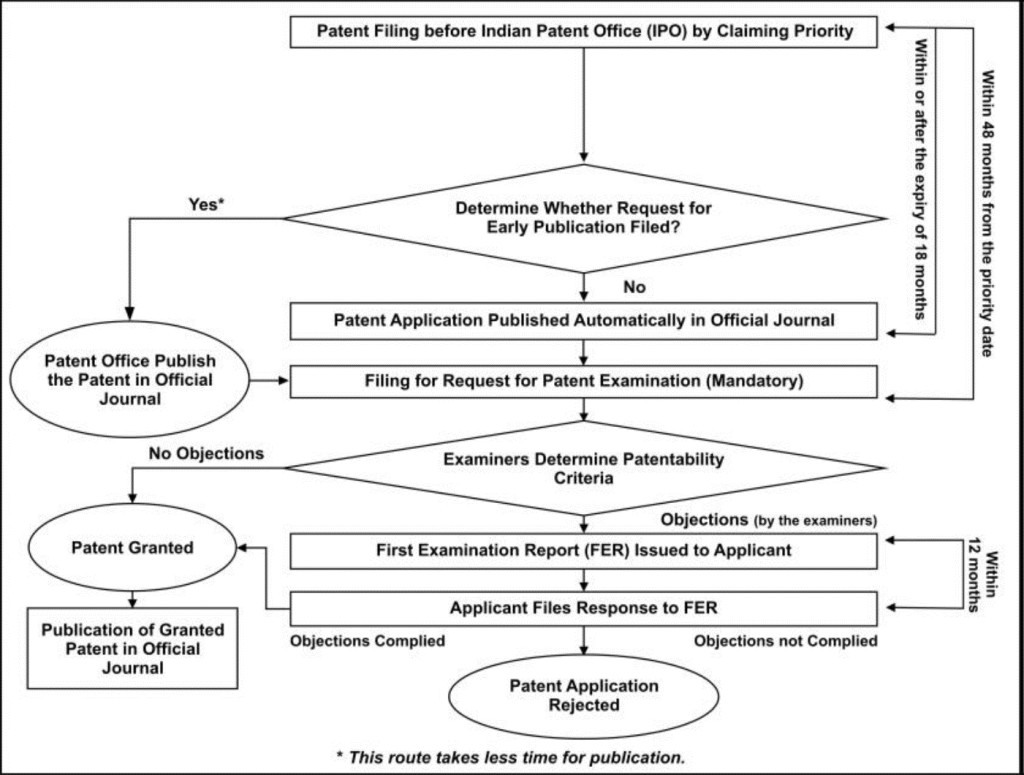
The application is published in the Official Patent Journal after 18 months (or earlier if requested).
Examination
Filing Request for Examination (RFE). The Patent Examiner reviews the specification for criteria compliance.
Objections Response
Drafting responses to clarify examiner queries and address objections in the Examination Report.
Grant & Certification
Upon resolving all objections, the patent is officially granted, and the certificate is issued.
Patent Registration Workflow Flowchart
Patent Office Fee Structure
Official statutory fee schedule for patent filings, extensions, renewals, and other procedural requests in India.
| Entry No | On What Payable / Action Description | Form No | For e-Filing (INR) | For Physical Filing (INR) |
|---|---|---|---|---|
| 1 |
On application for a patent under sections 7, 54 or 135 and rule 20(1) accompanied by provisional or complete specification—
*An application for a patent made under section 54 shall be eligible for a reduction of 50 per cent in fee as compared to other applications.
|
1 |
Natural / Startup / MSME
1600 (Multiple of 1600 in case of every multiple priority.)
Other Entities
8000 (Multiple of 8000 in case of every multiple priority.)
|
Natural / Startup / MSME
1750 (Multiple of 1750 in case of every multiple priority.)
Other Entities
8800 (Multiple of 8800 in case of every multiple priority.)
|
| (i) |
for each sheet of specification in addition to 30, excluding sequence listing of nucleotides and/ or amino acid sequences under sub-rule (3) of rule (9)
|
1 |
Natural / Startup / MSME
₹160
Other Entities
₹800
|
Natural / Startup / MSME
₹180
Other Entities
₹880
|
| (ii) |
for each claim in addition to 10
|
1 |
Natural / Startup / MSME
₹320
Other Entities
₹1600
|
Natural / Startup / MSME
₹350
Other Entities
₹1750
|
| (iii) |
for each page of sequence listing of nucleotides and/ or amino acid sequences under sub-rule (3) of rule (9)
|
1 |
Natural / Startup / MSME
160 (subject to a max of 24,000)
Other Entities
800 (subject to a max of 1,20,000)
|
Natural / Startup / MSME
Not allowed
Other Entities
Not allowed
|
| 2 |
On filing complete specification after provisional up to 30 pages having up to 10 claims –
Note: A specification in respect of an application for a patent made under section 54 shall be eligible for a reduction of 50 per cent in fee as compared to other specifications.
|
2 |
Natural / Startup / MSME
No fee
Other Entities
No fee
|
Natural / Startup / MSME
No fee
Other Entities
No fee
|
| 3 |
On filing a statement and undertaking under section 8.
|
3 |
Natural / Startup / MSME
No fee
Other Entities
No fee
|
Natural / Startup / MSME
No fee
Other Entities
No fee
|
| 4 (i) |
On request for extension of time under sections 53(2) and 142(4), rules 13(6), 80(1A) and 130
|
4 |
Natural / Startup / MSME
₹480
Other Entities
₹2400
|
Natural / Startup / MSME
₹530
Other Entities
₹2600
|
| 4 (ii) |
On request for extension of time or condonation of delay under sub-rule (4) of rule 12 or sub-rule (2) of rule 131
|
4 |
Natural / Startup / MSME
₹2000
Other Entities
₹10000
|
Natural / Startup / MSME
₹2200
Other Entities
₹11000
|
| 4 (iii) |
On request for extension of time under sub-rule (6) of rule 24B
|
4 |
Natural / Startup / MSME
₹1000
Other Entities
₹4000
|
Natural / Startup / MSME
₹1100
Other Entities
₹4400
|
| 4 (iv) |
On request for extension of time under sub-rule (11) of rule 24C
|
4 |
Natural / Startup / MSME
₹2000
Other Entities
₹10000
|
Natural / Startup / MSME
₹2200
Other Entities
₹11000
|
| 4 (v) |
On request for extension of time under rule 138
|
4 |
Natural / Startup / MSME
₹10000
Other Entities
₹50000
|
Natural / Startup / MSME
₹11000
Other Entities
₹55000
|
| 5 |
On filing a declaration as to inventorship under sub-rule (6) of rule 13.
|
5 |
Natural / Startup / MSME
No fee
Other Entities
No fee
|
Natural / Startup / MSME
No fee
Other Entities
No fee
|
| 6 |
On application for postdating.
|
— |
Natural / Startup / MSME
₹800
Other Entities
₹4000
|
Natural / Startup / MSME
₹880
Other Entities
₹4400
|
| 7 |
On application for deletion of reference under section 19(2).
|
— |
Natural / Startup / MSME
₹800
Other Entities
₹4000
|
Natural / Startup / MSME
₹880
Other Entities
₹4400
|
| 8 (i) |
On claim under section 20(1)
|
6 |
Natural / Startup / MSME
₹800
Other Entities
₹4000
|
Natural / Startup / MSME
₹880
Other Entities
₹4400
|
| 8 (ii) |
On request for direction under section 20(4) or 20(5)
|
6 |
Natural / Startup / MSME
₹800
Other Entities
₹4000
|
Natural / Startup / MSME
₹880
Other Entities
₹4400
|
| 9 (i) |
On notice of opposition to grant of patent under section 25(2)
|
7 / 7A |
Natural / Startup / MSME
₹8000
Other Entities
₹40000
|
Natural / Startup / MSME
Not allowed
Other Entities
Not allowed
|
| 9 (ii) |
On filing representation opposing grant of patent under section 25(1)
|
7 / 7A |
Natural / Startup / MSME
₹4000
Other Entities
₹20000
|
Natural / Startup / MSME
Not allowed
Other Entities
Not allowed
|
| 10 |
On giving notice that hearing before Controller shall be attended under rule 62(2).
|
— |
Natural / Startup / MSME
₹1500
Other Entities
₹7500
|
Natural / Startup / MSME
₹1700
Other Entities
₹8300
|
| 11 (i) |
On application under section 28(2)
|
8 |
Natural / Startup / MSME
No fee
Other Entities
No fee
|
Natural / Startup / MSME
No fee
Other Entities
No fee
|
| 12 |
Certificate of inventorship under rule 70A.
|
8A |
Natural / Startup / MSME
₹900
Other Entities
Not applicable
|
Natural / Startup / MSME
₹1000
Other Entities
Not applicable
|
| 13 |
Request for publication under section 11A(2) and rule 24A.
|
9 |
Natural / Startup / MSME
₹2500
Other Entities
₹12500
|
Natural / Startup / MSME
₹2750
Other Entities
₹13750
|
| 14 |
On application under section 44 for amendment of patent.
|
10 |
Natural / Startup / MSME
₹2400
Other Entities
₹12000
|
Natural / Startup / MSME
₹2650
Other Entities
₹13200
|
| 15 |
On application for directions under section 51(1) or 51(2).
|
11 |
Natural / Startup / MSME
₹2400
Other Entities
₹12000
|
Natural / Startup / MSME
₹2650
Other Entities
₹13200
|
| 16 |
On request for grant of a patent under sections 26(1) and 52(2).
|
12 |
Natural / Startup / MSME
₹2400
Other Entities
₹12000
|
Natural / Startup / MSME
₹2650
Other Entities
₹13200
|
| 17 |
On request for converting a patent of addition to an independent patent under section 55(1).
|
— |
Natural / Startup / MSME
₹2400
Other Entities
₹12000
|
Natural / Startup / MSME
₹2650
Other Entities
₹13200
|
| 18 (i) |
before the expiration of the 2nd year from the date of patent in respect of 3rd year
|
— |
Natural / Startup / MSME
₹800
Other Entities
₹4000
|
Natural / Startup / MSME
₹880
Other Entities
₹4400
|
| 18 (ii) |
before the expiration of the 3rd year in respect of the 4th year
|
— |
Natural / Startup / MSME
₹800
Other Entities
₹4000
|
Natural / Startup / MSME
₹880
Other Entities
₹4400
|
| 18 (iii) |
before the expiration of the 4th year in respect of the 5th year
|
— |
Natural / Startup / MSME
₹800
Other Entities
₹4000
|
Natural / Startup / MSME
₹880
Other Entities
₹4400
|
| 18 (iv) |
before the expiration of the 5th year in respect of the 6th year
|
— |
Natural / Startup / MSME
₹800
Other Entities
₹4000
|
Natural / Startup / MSME
₹880
Other Entities
₹4400
|
| 18 (v) |
before the expiration of the 6th year in respect of the 7th year
|
— |
Natural / Startup / MSME
₹2400
Other Entities
₹12000
|
Natural / Startup / MSME
₹2650
Other Entities
₹13200
|
| 18 (vi) |
before the expiration of the 7th year in respect of the 8th year
|
— |
Natural / Startup / MSME
₹2400
Other Entities
₹12000
|
Natural / Startup / MSME
₹2650
Other Entities
₹13200
|
| 18 (vii) |
before the expiration of the 8th year in respect of the 9th year
|
— |
Natural / Startup / MSME
₹2400
Other Entities
₹12000
|
Natural / Startup / MSME
₹2650
Other Entities
₹13200
|
| 18 (viii) |
before the expiration of the 9th year in respect of the 10th year
|
— |
Natural / Startup / MSME
₹2400
Other Entities
₹12000
|
Natural / Startup / MSME
₹2650
Other Entities
₹13200
|
| 18 (ix) |
before the expiration of the 10th year in respect of the 11th year
|
— |
Natural / Startup / MSME
₹4800
Other Entities
₹24000
|
Natural / Startup / MSME
₹5300
Other Entities
₹26400
|
| 18 (x) |
before the expiration of the 11th year in respect of the 12th year
|
— |
Natural / Startup / MSME
₹4800
Other Entities
₹24000
|
Natural / Startup / MSME
₹5300
Other Entities
₹26400
|
| 18 (xi) |
before the expiration of the 12th year in respect of the 13th year
|
— |
Natural / Startup / MSME
₹4800
Other Entities
₹24000
|
Natural / Startup / MSME
₹5300
Other Entities
₹26400
|
| 18 (xii) |
before the expiration of the 13th year in respect of the 14th year
|
— |
Natural / Startup / MSME
₹4800
Other Entities
₹24000
|
Natural / Startup / MSME
₹5300
Other Entities
₹26400
|
| 18 (xiii) |
before the expiration of the 14th year in respect of the 15th year
|
— |
Natural / Startup / MSME
₹4800
Other Entities
₹24000
|
Natural / Startup / MSME
₹5300
Other Entities
₹26400
|
| 18 (xiv) |
before the expiration of the 15th year in respect of the 16th year
|
— |
Natural / Startup / MSME
₹8000
Other Entities
₹40000
|
Natural / Startup / MSME
₹8800
Other Entities
₹44000
|
| 18 (xv) |
before the expiration of the 16th year in respect of the 17th year
|
— |
Natural / Startup / MSME
₹8000
Other Entities
₹40000
|
Natural / Startup / MSME
₹8800
Other Entities
₹44000
|
| 18 (xvi) |
before the expiration of the 17th year in respect of the 18th year
|
— |
Natural / Startup / MSME
₹8000
Other Entities
₹40000
|
Natural / Startup / MSME
₹8800
Other Entities
₹44000
|
| 18 (xvii) |
before the expiration of the 18th year in respect of the 19th year
|
— |
Natural / Startup / MSME
₹8000
Other Entities
₹40000
|
Natural / Startup / MSME
₹8800
Other Entities
₹44000
|
| 18 (xviii) |
before the expiration of the 19th year in respect of the 20th year
|
— |
Natural / Startup / MSME
₹8000
Other Entities
₹40000
|
Natural / Startup / MSME
₹8800
Other Entities
₹44000
|
| 19 (i) |
On application for amendment of application for patent or complete specification or other related documents under section 57— (i) before grant of patent;
|
13 |
Natural / Startup / MSME
₹800
Other Entities
₹4000
|
Natural / Startup / MSME
₹880
Other Entities
₹4400
|
| 19 (ii) |
after grant of patent
|
13 |
Natural / Startup / MSME
₹1600
Other Entities
₹8000
|
Natural / Startup / MSME
₹1750
Other Entities
₹8800
|
| 19 (iii) |
where amendment is for changing name, address, nationality or address for service
|
13 |
Natural / Startup / MSME
₹320
Other Entities
₹1600
|
Natural / Startup / MSME
₹350
Other Entities
₹1750
|
| 20 |
On notice of opposition under sections 57(4), 61(1) and 87(2) or to surrender a patent under section 63(3) or to request under section 78(5).
|
14 |
Natural / Startup / MSME
₹2400
Other Entities
₹12000
|
Natural / Startup / MSME
₹2650
Other Entities
₹13200
|
| 21 |
On application for restoration of a patent under section 60.
|
15 |
Natural / Startup / MSME
₹2400
Other Entities
₹12000
|
Natural / Startup / MSME
₹2650
Other Entities
₹13200
|
| 22 |
Additional fee for restoration under section 61(3) and rule 86(1).
|
— |
Natural / Startup / MSME
₹4800
Other Entities
₹24000
|
Natural / Startup / MSME
₹5300
Other Entities
₹26400
|
| 23 |
On notice of offer to surrender a patent under section 63.
|
— |
Natural / Startup / MSME
No fee
Other Entities
No fee
|
Natural / Startup / MSME
No fee
Other Entities
No fee
|
| 24 |
On application for the entry in the register of patents of the name of a person entitled to a patent or as a share or as a mortgage or as licensee or as otherwise or for the entry in the register of patents of notification of a document under sections 69(1) or 69(2) and rules 90(1) or 90(2).
|
16 |
Natural / Startup / MSME
1600 (per patent)
Other Entities
8000 (per patent)
|
Natural / Startup / MSME
1750 (per patent)
Other Entities
8800 (per patent)
|
| 25 |
On application for alteration of an entry in the register of patents or register of patent agents under rules 94(1) or rule 118(1).
|
— |
Natural / Startup / MSME
₹320
Other Entities
₹1600
|
Natural / Startup / MSME
₹350
Other Entities
₹1750
|
| 26 |
On request for entry of an additional address for service in the Register of Patents under rule 94(3).
|
— |
Natural / Startup / MSME
₹800
Other Entities
₹4000
|
Natural / Startup / MSME
₹880
Other Entities
₹4400
|
| 27 |
On application for compulsory license under sections 84(1), 91(1), 92(1) and 92A.
|
17 |
Natural / Startup / MSME
₹2400
Other Entities
₹12000
|
Natural / Startup / MSME
₹2650
Other Entities
₹13200
|
| 28 (i) |
under section 11B and rule 24(1)
|
18 |
Natural / Startup / MSME
₹4000
Other Entities
₹20000
|
Natural / Startup / MSME
₹4400
Other Entities
₹22000
|
| 28 (ii) |
under rule 20(4)(ii)
|
18 |
Natural / Startup / MSME
₹5600
Other Entities
₹28000
|
Natural / Startup / MSME
₹6150
Other Entities
₹30800
|
| 29 |
On request for expedited or delayed examination of application for patent under rule 24C.
|
18A |
Natural / Startup / MSME
₹8000
Other Entities
₹60000
|
Natural / Startup / MSME
Not allowed
Other Entities
Not allowed
|
| 30 |
Conversion of the request for examination filed under rule 24B to request for expedited or delayed examination under rule 24C.
|
18A |
Natural / Startup / MSME
₹4000
Other Entities
₹40000
|
Natural / Startup / MSME
Not allowed
Other Entities
Not allowed
|
| 31 |
On application for revocation of a patent under section 85(1).
|
19 |
Natural / Startup / MSME
₹2400
Other Entities
₹12000
|
Natural / Startup / MSME
₹2650
Other Entities
₹13200
|
| 32 |
On application for revision of terms and conditions of licence under section 88(4).
|
20 |
Natural / Startup / MSME
₹2400
Other Entities
₹12000
|
Natural / Startup / MSME
₹2650
Other Entities
₹13200
|
| 33 |
On request for termination of compulsory licence under section 94.
|
21 |
Natural / Startup / MSME
₹2400
Other Entities
₹12000
|
Natural / Startup / MSME
₹2650
Other Entities
₹13200
|
| 34 |
On application for registration as a patent agent under rule 109(1) or rule 112.
|
22 |
Natural / Startup / MSME
₹3200
Other Entities
Not applicable
|
Natural / Startup / MSME
₹3500
Other Entities
Not applicable
|
| 35 |
On request for appearing in the qualifying examination under rule 109(3).
|
— |
Natural / Startup / MSME
₹1600
Other Entities
Not applicable
|
Natural / Startup / MSME
₹1750
Other Entities
Not applicable
|
| 36 (i) |
for the 1st year to be paid along with registration
|
— |
Natural / Startup / MSME
₹800
Other Entities
Not applicable
|
Natural / Startup / MSME
₹880
Other Entities
Not applicable
|
| 36 (ii) |
for every year excluding the 1st year to be paid on the 1st April in each year.
|
— |
Natural / Startup / MSME
₹800
Other Entities
Not applicable
|
Natural / Startup / MSME
₹880
Other Entities
Not applicable
|
| 37 |
On application for duplicate certificate of patent agent under rule 111A.
|
— |
Natural / Startup / MSME
₹1600
Other Entities
Not applicable
|
Natural / Startup / MSME
₹1750
Other Entities
Not applicable
|
| 38 |
On application for restoration of the name of a person in the register of patent agents under rule 117(1).
|
23 |
Natural / Startup / MSME
1600 (Plus continuation fee under entry 36)
Other Entities
Not applicable
|
Natural / Startup / MSME
1750 (Plus continuation fee under entry 36)
Other Entities
Not applicable
|
| 39 |
On a request for correction of clerical error under section 78(2).
|
— |
Natural / Startup / MSME
₹800
Other Entities
₹4000
|
Natural / Startup / MSME
₹880
Other Entities
₹4400
|
| 40 |
On application for review or setting aside the decision or order of the controller under section 77(1)(f) or 77(1)(g).
|
24 |
Natural / Startup / MSME
₹1600
Other Entities
₹8000
|
Natural / Startup / MSME
₹1750
Other Entities
₹8800
|
| 41 |
On application for permission for applying patent outside India under section 39 and rule 71(1).
|
25 |
Natural / Startup / MSME
₹1600
Other Entities
₹8000
|
Natural / Startup / MSME
₹1750
Other Entities
₹8800
|
| 42 |
On application for duplicate patent under section 154 and rule 132.
|
— |
Natural / Startup / MSME
₹1600
Other Entities
₹8000
|
Natural / Startup / MSME
₹1750
Other Entities
₹8800
|
| 43 (i) |
On request for certified copies under section 72 or for certificate under section 147 and rule 133(1)
|
— |
Natural / Startup / MSME
1000 (up to 30 pages, thereafter 30/page)
Other Entities
5000 (up to 30 pages, thereafter 150/page)
|
Natural / Startup / MSME
1100 (up to 30 pages, thereafter 30/page)
Other Entities
5500 (up to 30 pages, thereafter 150/page)
|
| 43 (ii) |
On request for certified copies under section 72 or for certificate under section 147 and rule 133(2)
|
— |
Natural / Startup / MSME
2400 (up to 30 pages, thereafter 30/page)
Other Entities
12000 (up to 30 pages, thereafter 150/page)
|
Natural / Startup / MSME
3300 (up to 30 pages, thereafter 30/page)
Other Entities
13200 (up to 30 pages, thereafter 150/page)
|
| 44 |
For certifying office copies, printed each.
|
— |
Natural / Startup / MSME
₹800
Other Entities
₹4000
|
Natural / Startup / MSME
₹880
Other Entities
₹4400
|
| 45 |
On request for inspection of register under section 72, inspection under rule 27 or rule 74A.
|
— |
Natural / Startup / MSME
₹320
Other Entities
₹1600
|
Natural / Startup / MSME
₹350
Other Entities
₹1750
|
| 46 |
On request for information under section 153 and rule 134.
|
— |
Natural / Startup / MSME
₹480
Other Entities
₹2400
|
Natural / Startup / MSME
₹530
Other Entities
₹2650
|
| 47 |
On form of authorization of a patent agent.
|
26 |
Natural / Startup / MSME
No fee
Other Entities
No fee
|
Natural / Startup / MSME
No fee
Other Entities
No fee
|
| 48 |
On petition not otherwise provided for.
|
— |
Natural / Startup / MSME
₹1600
Other Entities
₹8000
|
Natural / Startup / MSME
₹1750
Other Entities
₹8800
|
| 49 |
For supplying of photocopies of the documents, per page.
|
— |
Natural / Startup / MSME
₹10
Other Entities
₹10
|
Natural / Startup / MSME
₹10
Other Entities
₹10
|
| 50 |
Transmittal fee for international application.
|
— |
Natural / Startup / MSME
₹3200
Other Entities
₹16000
|
Natural / Startup / MSME
₹3500
Other Entities
₹17600
|
| 51 |
Transmittal fee for international application (for ePCT filing).
|
— |
Natural / Startup / MSME
No fee
Other Entities
No fee
|
Natural / Startup / MSME
Not applicable
Other Entities
Not applicable
|
| 52 |
For preparation of certified copy of priority document and for transmission of the same to the International Bureau of World Intellectual Property Organization.
|
— |
Natural / Startup / MSME
1000 (up to 30 pages, thereafter 30/page)
Other Entities
5000 (up to 30 pages, thereafter 150/page)
|
Natural / Startup / MSME
1100 (up to 30 pages, thereafter 30/page)
Other Entities
5500 (up to 30 pages, thereafter 150/page)
|
| 53 |
For preparation of certified copy of priority document and e-transmission through WIPO DAS.
|
— |
Natural / Startup / MSME
No fee
Other Entities
No fee
|
Natural / Startup / MSME
Not applicable
Other Entities
Not applicable
|
| 54 |
On statement regarding working of a patented invention on a commercial scale in India under section 146(2) and rule 131(1).
|
27 |
Natural / Startup / MSME
No fee
Other Entities
No fee
|
Natural / Startup / MSME
No fee
Other Entities
No fee
|
| 55 |
To be submitted for claiming the status of a small entity or startup.
|
28 |
Natural / Startup / MSME
No fee
Other Entities
No fee
|
Natural / Startup / MSME
No fee
Other Entities
No fee
|
| 56 |
Application for withdrawing the application under section 11B(4), and rules 7(4A) and 26.
|
29 |
Natural / Startup / MSME
No fee
Other Entities
No fee
|
Natural / Startup / MSME
No fee
Other Entities
No fee
|
| 57 |
Request for adjournment of hearing under rule 129A (for each adjournment).
|
— |
Natural / Startup / MSME
₹1000
Other Entities
₹5000
|
Natural / Startup / MSME
₹1100
Other Entities
₹5500
|
| 58 |
Miscellaneous form under rule 8(2), to be used when no other form is prescribed.
|
30 |
Natural / Startup / MSME
As applicable
Other Entities
As applicable
|
Natural / Startup / MSME
As applicable
Other Entities
As applicable
|
| 59 |
Grace period.
|
31 |
Natural / Startup / MSME
₹500
Other Entities
₹2500
|
Natural / Startup / MSME
₹550
Other Entities
2750*
|